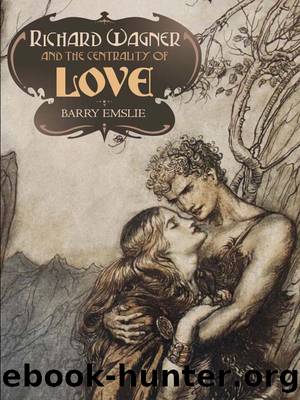
Richard Wagner and the Centrality of Love by Barry Emslie
Author:Barry Emslie
Language: eng
Format: epub
Publisher: Boydell & Brewer Group Ltd
Published: 2013-03-18T00:00:00+00:00
We might feel that this notion of roots transcends in metaphor and meaning what we generally call the cultural sphere, although it is productive of that sphere. That is, just as Freud explains the birth of culture as the psychic consequence of a wholly anthropological and communal act (the first act of âFather Killingâ â a matter, as we will see, that is scarcely irrelevant for Parsifal), Wagner begins with language as the first step in myth making and cultural development. One sees that the elements he is foregrounding here are not only chronologically on the first place, they have an (anthropological) quality which raises them above the conditional and arbitrary sphere of culture as we experience it now. We also note in the above that at this stage âman could speak his feelings.â When we turn to Opera and Drama we will meet more unambiguously what is here merely implied; namely, that there is an essentialist, biological configuration to all this. These roots, as it were, go as deep as roots can go and therefore we should not be surprised to learn that biology and culture are in their origins indissoluble.
âMusic is womanâ says Wagner. More than this, music is âthe bearing woman.â The poet, meanwhile, is âthe begetterâ. Woman is also, and intrinsically, âloveâ; but a âreceiving ⦠unreservedly surrendering loveâ [II: 111f]. The aesthetic marriage between the male begetter and the receptive woman is unremittingly portrayed by Wagner in sexual terms. As a result, there is a clear parallel between the inseparable link, on the one hand, between the âliving Folkâs melodyâ and the âliving Folkâs poemâ and, on the other hand, the act of fertilisation that takes place between the female embodiment of music when she duly and ecstatically accepts the male poet. Conception (Empfängnis) occurs in such a way that it is hard â and possibly improper to try â to disentangle the biological from the cultural and from the spiritual. A woman, for instance, is âsoullessâ until âshe receives her soul through the love of a man.â In passing we should also note that these categories enable Wagner to engineer a further ideological and aesthetic shift that, we might think, has also more to do with playing fast and loose with metaphor than with stringent cultural and anthropological analysis. It is, moreover, one that is very relevant to the last scene of Siegfried. While the woman must surrender completely if she is to be true to her deepest intrinsic nature (âthe true woman loves unconditionally, because she mustâ), it is understandable if, as prelude to the necessary act of surrender, she struggles somewhat; if she feels a certain pride in the expression of her own âWillâ. But this is all dialectically accounted for in the most nebulous terms so that opposites merrily spill over into, and confirm, each other. Clearly, some kind of struggle goes on between a certain âconstraintâ that the woman feels when confronted by the male who is going to impregnate
Download
This site does not store any files on its server. We only index and link to content provided by other sites. Please contact the content providers to delete copyright contents if any and email us, we'll remove relevant links or contents immediately.
| Classical | Country & Folk |
| Heavy Metal | Jazz |
| Pop | Punk |
| Rap & Hip-Hop | Rhythm & Blues |
| Rock |
Cecilia; Or, Memoirs of an Heiress — Volume 2 by Fanny Burney(31956)
Cecilia; Or, Memoirs of an Heiress — Volume 3 by Fanny Burney(31942)
Fanny Burney by Claire Harman(26603)
We're Going to Need More Wine by Gabrielle Union(19046)
Plagued by Fire by Paul Hendrickson(17413)
All the Missing Girls by Megan Miranda(16029)
Cat's cradle by Kurt Vonnegut(15357)
For the Love of Europe by Rick Steves(14121)
Bombshells: Glamour Girls of a Lifetime by Sullivan Steve(14076)
Leonardo da Vinci by Walter Isaacson(13337)
4 3 2 1: A Novel by Paul Auster(12393)
The remains of the day by Kazuo Ishiguro(9000)
Adultolescence by Gabbie Hanna(8927)
Note to Self by Connor Franta(7671)
Diary of a Player by Brad Paisley(7581)
Giovanni's Room by James Baldwin(7346)
What Does This Button Do? by Bruce Dickinson(6207)
Ego Is the Enemy by Ryan Holiday(5450)
Born a Crime by Trevor Noah(5383)
